

 Tiếng Việt
RARE DISEASE
RECOVERY THROUGH A PAIN-FREE BIOLOGICAL APPROACH
Baby Ngoc, from Tay Ninh, was born at the 30th week of pregnancy – a premature infant with fragile skin and a weakened immune system. Shortly after birth, large blisters began to appear across the body, accompanied by bright red areas of peeling skin on the hands and feet.
Doctors later diagnosed the baby with Epidermolysis Bullosa (EB), a rare inherited disorder in which the structural layers of the skin fail to properly adhere to each other. Even the slightest friction can cause severe blistering, open wounds, and continuous fluid leakage.
Currently, there is no definitive cure for EB. Medical care largely focuses on infection control and wound management. However, the treatment process itself can be extremely painful: frequent bandage changes, prolonged antibiotic use, corticosteroids, and constant pain management. Meanwhile, the baby’s delicate skin continues to tear and blister almost daily.
Home-based biological care – a gentle turning point
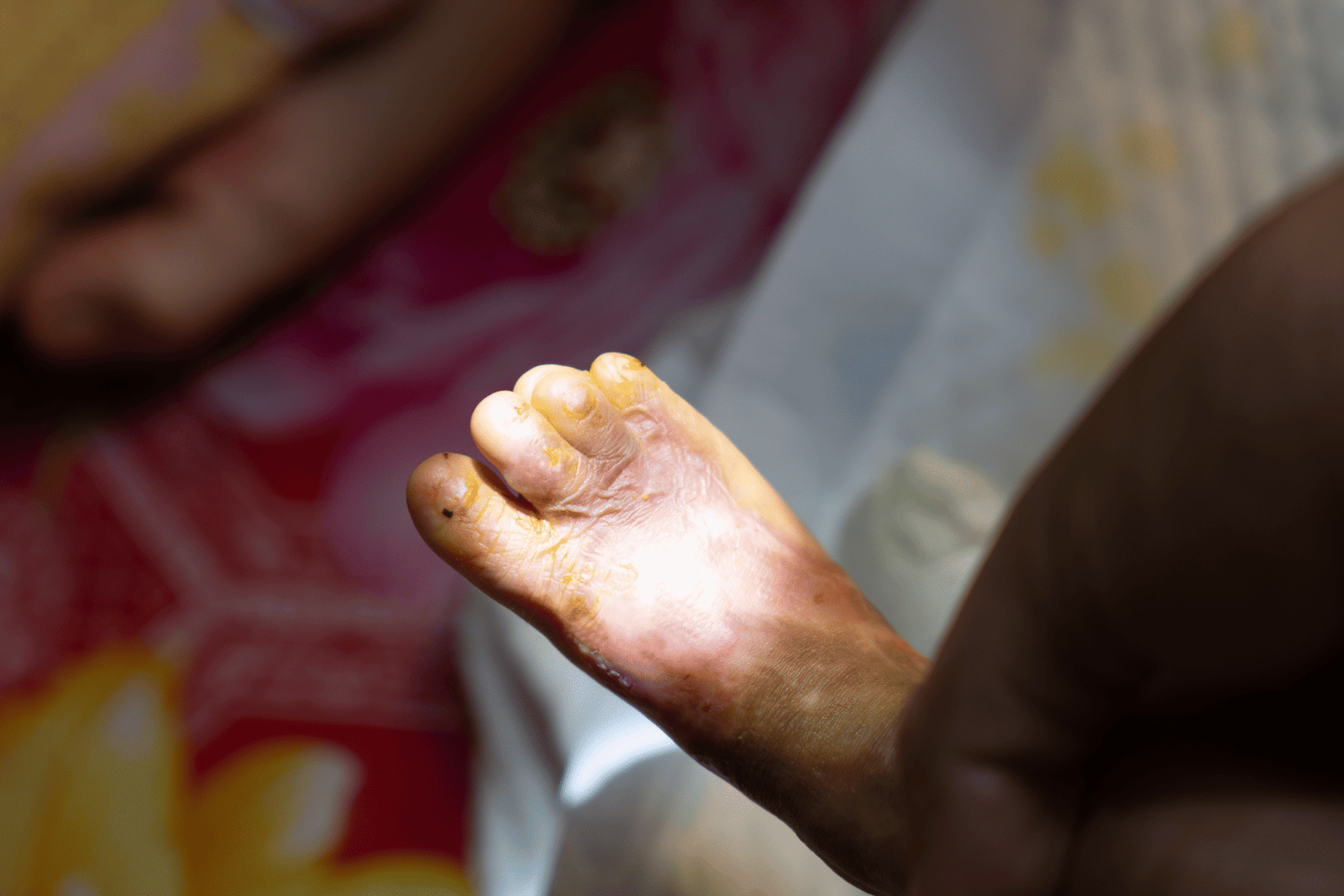
Starting in August 2024, Baby Ngoc began receiving home-based care using a biological gel formulated with DKD’s proprietary phospholipid excipient. The topical formulation was applied without the need for antibiotics, corticosteroids, anesthesia, or complex bandaging procedures. The lightweight gel gently penetrates the affected areas and forms a protective lipid-based biological film over the epithelium. This layer helps reduce microbial contamination while minimizing mechanical friction on the fragile skin surface. Within several days of use, the lesions gradually began to dry, with reduced exudate and inflammation. The pseudo-membrane detached naturally, revealing newly regenerated skin with a more uniform color and soft texture.
No drug dependency – no secondary infection – yet clear recovery
Since hospital discharge in September 2024, the baby has not required any systemic medication. Daily care consists simply of gentle cleansing with physiological saline followed by topical gel application twice per day. No antibiotics, no analgesics, and no sedatives were required. Despite this minimal intervention, the wounds did not expand, no necrotic lesions developed, and no contractile scarring was observed.
Outcome after nearly one year: a recovering body – a protected childhood
- Previously affected areas gradually dried and the superficial skin layer detached naturally without hypertrophic scarring
- Newly regenerated skin appeared soft and evenly pigmented, without deformity of the knee or ankle joints
- The baby is now able to move the legs freely, practice standing, and begin taking early steps
- No hospital readmission has been required since September 2024
Khám phá ứng dụng tá dược thế hệ mới – giải pháp sinh học thiên nhiên cho bé EB thể nặng
Thấu hiểu những đứa trẻ mắc EB nặng buộc phải dùng thuốc ngăn nhiễm trùng thường xuyên, DKD phát triển một công thức tá dược sinh học với ba đột phá chính:
From a single case – toward a new direction
The case of Baby Ngoc represents an important milestone. Through an unexpected opportunity to use PL PRO, the observed improvement in a severe form of Epidermolysis Bullosa raised a broader scientific question for the DKD research team.
Could a phospholipid-based excipient platform be extended to support the treatment of other rare diseases?
This question gradually shaped a new research direction: to further explore genetic disorders, rare diseases, and biomimetic excipient systems that may support non-invasive therapeutic approaches.
DKD hopes to collaborate with hospitals, researchers, and medical organizations worldwide to develop a humanitarian pharmaceutical ecosystem — one where even the most fragile children may have access to healing, delivered in the gentlest possible way.

PEDIATRIC BURNS
The visible traces of a burn accident gradually disappeared — leaving behind healthy skin and a child’s smile. The family agreed to share this story as a source of hope, so that more children may access safe and gentle treatment approaches…

CHRONIC WOUNDS
After 32 years in a wheelchair due to a severe accident, a patient faced the risk of leg amputation from deep tissue necrosis. During the waiting period before surgery, the wound gradually recovered and the patient was discharged without requiring amputation…
ATOPIC DERMATITIS
A journey lasting more than a decade, where the disease was not only on the skin but also weighed heavily on the mind. From desperate attempts at treatment to the quiet moment of beginning again — as a way of saving oneself…